You’re looking for PancakeSwap v2 on Ethereum. You want the low fees of PancakeSwap but the security and asset variety of the Ethereum network. Here is the hard truth: that product does not exist. If you are trying to find a native PancakeSwap interface running directly on the Ethereum mainnet, you will hit a dead end. This confusion is common because the decentralized finance (DeFi) space moves fast, and names get mixed up. But understanding this distinction is critical before you connect your wallet and risk your funds.
This review clears up the misconception about PancakeSwap’s network presence, explains why it operates exclusively on Binance Smart Chain (BSC), and evaluates whether the platform still holds value for traders in 2026. We will look at the actual fee structures, the risks involved, and how it compares to true Ethereum-based alternatives like Uniswap.
The Core Misconception: PancakeSwap Is Not on Ethereum
To trade on PancakeSwap, you must use the Binance Smart Chain (BSC), also known as BNB Chain. PancakeSwap was built from the ground up to leverage BSC’s architecture. It does not run its core automated market maker (AMM) pools on Ethereum. While the PancakeSwap team has introduced multi-chain routing features that allow users to access assets on other networks, the primary liquidity, the V2 and V3 pools, and the majority of the user base reside on BSC.
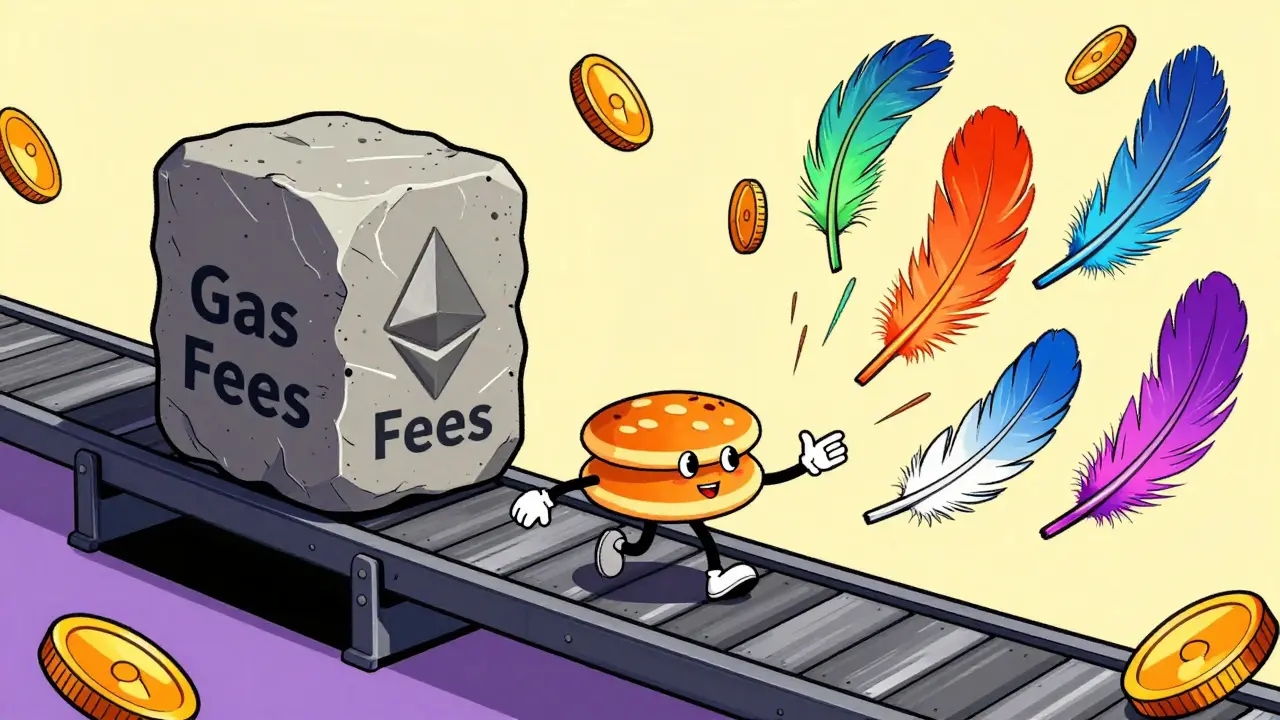
Why does this matter? Because the two blockchains have fundamentally different cost structures and security models. Ethereum is often compared to a high-security bank vault with slow processing times and high insurance premiums (gas fees). BSC is more like a busy convenience store-fast, cheap, but with different security protocols. When you try to force PancakeSwap onto Ethereum, you lose the primary benefit that made it popular in the first place: ultra-low transaction costs.
| Feature | Binance Smart Chain (BSC) | Ethereum Mainnet |
|---|---|---|
| Average Transaction Fee (2026) | $0.10 - $0.50 | $2.00 - $20.00+ |
| Block Time | ~3 seconds | ~12 seconds |
| Primary Token Standard | BEP-20 | ERC-20 |
| Security Model | Federated Validator Set | Proof-of-Stake (Decentralized) |
How PancakeSwap v2 Actually Works
Since we established that you are trading on BSC, let’s look at what you are actually getting with PancakeSwap v2. This version of the protocol uses a standard AMM model. You swap tokens by interacting with liquidity pools rather than an order book. The most important thing to know here is the fee structure.
PancakeSwap v2 charges a flat 0.25% trading fee on all swaps. This is significantly lower than many centralized exchanges that charge between 0.1% and 0.5% plus withdrawal fees. For small trades, this efficiency is massive. If you are swapping $10 worth of tokens, you pay 2.5 cents in fees. On Ethereum, even if the exchange fee were zero, you might pay $5 in gas just to execute the transaction.
The process is straightforward:
- Connect a compatible wallet like MetaMask or Trust Wallet.
- Ensure your wallet is switched to the BNB Chain network.
- Select the token pair you want to trade (e.g., BNB to CAKE).
- Confirm the slippage tolerance (usually 0.5% to 1% is safe for stable pairs).
- Approve the transaction in your wallet.
It’s simple, but simplicity comes with trade-offs. You don’t have customer support. If you send tokens to the wrong address, they are gone forever. There is no "undo" button in DeFi.
V2 vs. V3: Should You Upgrade?
Many users stick with v2 out of habit, but PancakeSwap v3 offers concentrated liquidity. This allows liquidity providers to place their capital within specific price ranges, increasing capital efficiency. For traders, this means tighter spreads and potentially better prices for large orders.
V3 introduces variable fee tiers: 0.01%, 0.05%, 0.25%, and 1%. If you are trading volatile meme coins, you might encounter a 1% fee tier. If you are trading stablecoins like BUSD to USDT, you can often find 0.01% or 0.05% tiers. Before you trade, check which version of the pool you are accessing. The interface usually indicates this clearly, but it pays to double-check.
Risks You Can’t Ignore
In 2026, the regulatory landscape for DeFi is tightening. PancakeSwap operates as an unregulated entity. This means there is no central authority to protect your funds if something goes wrong. The platform’s TU Overall Score reflects this higher-than-average risk profile.
Here are the specific risks you face:
- Smart Contract Risk: Although PancakeSwap’s contracts are audited, bugs can still exist. A vulnerability could theoretically be exploited, leading to loss of funds in the pool.
- Impermanent Loss: If you provide liquidity, you might end up with less value than if you had just held the tokens. This happens when the price ratio of the paired assets changes significantly.
- Phishing Attacks: Because there is no login page, scammers create fake PancakeSwap websites. Always verify the URL is pancakeswap.finance. Never click links from social media DMs.
- No Recourse: There is no customer service chat. If you make a mistake, you are on your own.
Who Is PancakeSwap For?
PancakeSwap is not for everyone. It is best suited for experienced DeFi users who understand how wallets work and are comfortable managing their own private keys. It is ideal for:
- Traders who prioritize low fees over maximum decentralization.
- Users already holding BNB who want to swap into other BEP-20 tokens.
- Yield farmers looking to earn rewards from liquidity provision.
If you are a beginner who wants to buy Bitcoin or Ethereum directly with a credit card, PancakeSwap is the wrong tool. You need a centralized exchange like Coinbase or Binance for fiat on-ramps. If you demand the highest level of security and deep liquidity for major pairs like ETH/USDC, you should look at Uniswap on Ethereum or Arbitrum.

Alternatives to Consider
If you specifically need Ethereum-based trading, consider these alternatives:
- Uniswap: The gold standard for Ethereum DEXs. Higher fees, but deeper liquidity and stronger security track record.
- SushiSwap: Available on both Ethereum and BSC, offering a middle ground.
- 1inch: An aggregator that finds the best price across multiple DEXs, including PancakeSwap and Uniswap. This is often the smartest choice for minimizing slippage.
Final Verdict
PancakeSwap v2 is a robust, efficient trading platform-but only on Binance Smart Chain. Do not waste time looking for an Ethereum version; it doesn’t exist. If you are willing to accept the security trade-offs of BSC for the sake of low fees and fast transactions, PancakeSwap remains one of the top choices in 2026. Just remember to start small, verify every contract address, and never invest more than you can afford to lose.
Is PancakeSwap available on Ethereum?
No, PancakeSwap primarily operates on Binance Smart Chain (BSC). While it has multi-chain routing capabilities, its core liquidity and V2/V3 pools are not natively deployed on the Ethereum mainnet.
What is the fee for PancakeSwap v2?
PancakeSwap v2 charges a fixed 0.25% trading fee on all swaps. This is generally lower than the combined cost of trading fees and gas on Ethereum-based DEXs.
Can I trade Bitcoin on PancakeSwap?
You cannot trade native Bitcoin (BTC) on PancakeSwap. You can trade wrapped versions of Bitcoin (like wBTC) if they are supported on BSC, but these are ERC-20/BEP-20 equivalents, not the native blockchain asset.
Is PancakeSwap safe to use in 2026?
PancakeSwap is widely used and has been audited, but it carries inherent DeFi risks. It is unregulated, and users bear full responsibility for their funds. Smart contract vulnerabilities and phishing attacks remain significant threats.
What wallets work with PancakeSwap?
PancakeSwap supports popular Web3 wallets that interact with BSC, including MetaMask, Trust Wallet, WalletConnect, and the Binance Smart Wallet.