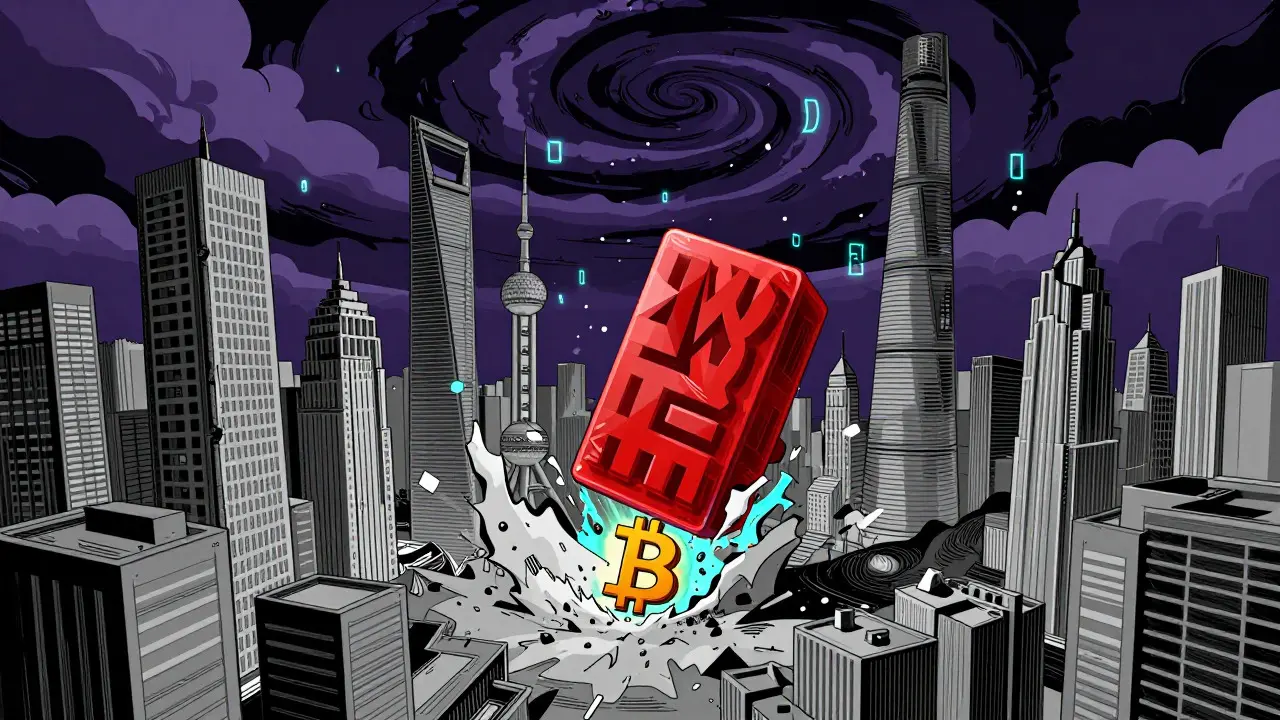
Imagine trying to buy a coffee with Bitcoin in Shanghai today. It won't happen. In fact, holding a single satoshi of Bitcoin is now technically illegal for most residents of mainland China. This isn't just a policy shift; it's a total lockdown. Effective June 1, 2025, the People's Bank of China issued Circular No.237, a comprehensive regulatory order that bans all cryptocurrency activities, including trading, mining, and individual ownership. For anyone living in or doing business with China, this changes everything about how you think about digital assets.
The situation has moved far beyond simple regulation. We are talking about a complete prohibition enforced by police crackdowns and bank surveillance. If you are a Chinese citizen looking to access global markets, or an investor wondering why Asian markets react differently to US news, you need to understand the mechanics of this ban. It is not just about price caps or taxes; it is about cutting off the financial plumbing that connects fiat currency to crypto assets.
What Does Circular No.237 Actually Prohibit?
To understand the severity, we have to look at the specific text of the regulation. Circular No.237 is a legal instrument issued on May 30, 2025, that classifies all cryptocurrency-related business activities as illegal financial activities. Before this, there were gray areas. You could argue that holding coins was private property. Now, that ambiguity is gone. The ban covers six main categories of activity:
- Cryptocurrency derivative trading
- Providing information intermediation and pricing services
- Exchanging legal tender (yuan) with cryptocurrency
- Direct exchange between cryptocurrencies
- Acting as a central counterparty for buying and selling
- Token issuance financing (essentially banning new ICOs)
This means that if you open an account on a foreign exchange like Binance or OKX using a Chinese ID, you are engaging in an illegal financial activity. The law doesn't just target the exchanges; it targets the user. More than ten major cryptocurrency exchanges announced their withdrawal from the mainland market within one month of the promulgation. They didn't leave because they wanted to; they left because staying meant fighting a government with unlimited enforcement power.
How Banks and Alipay Enforce the Ban
You might wonder how the government stops people who use VPNs and foreign banks. The answer lies in controlling the on-ramps. The PBOC ordered major banks and payment giants like Alipay is a dominant mobile payment platform in China that was mandated to cut off payment channels for crypto transactions. These institutions are required to identify and restrict any flow of funds that looks like it’s heading toward crypto.
The enforcement is technologically sophisticated. Financial institutions must now implement enhanced monitoring systems to detect abnormal transactions. What does "abnormal" mean? It often means large transfers to unknown entities, frequent small transfers to OTC brokers, or payments to known crypto service providers. If your bank sees a pattern that suggests you are moving money to buy Tether (USDT), they can freeze your account pending investigation.
In July 2025, police and regulators conducted coordinated crackdowns specifically targeting schemes using Tether is the largest stablecoin used for cross-border transfers, which became a primary target for anti-capital outflow operations. This wasn't just about stopping crypto adoption; it was about stopping capital flight. As the Yuan faced depreciation pressure, every dollar converted to USDT and sent abroad was seen as a threat to national financial stability. By cutting off the pipe, they dry up the source.
The Timeline: From Warnings to Total Prohibition
This didn't happen overnight. China’s approach has been a slow tightening of the screws over twelve years. Understanding this timeline helps explain why the current ban feels so absolute.
| Date | Action | Impact |
|---|---|---|
| Dec 2013 | Notice on Preventing Bitcoin Risks | Banks banned from processing BTC transactions |
| Sep 2017 | ICO Ban Announcement | 24 ICO platforms shut down; domestic exchanges closed |
| Jun 2021 | Mining Ban | Miners forced to move overseas (e.g., to Texas, Kazakhstan) |
| Sep 2021 | Trading Ban | De facto ban on retail trading; only institutional research allowed |
| Jun 2025 | Circular No.237 | Total ban on ownership, trading, and mining for individuals |
Each step removed a piece of the ecosystem. First, they stopped the banks. Then, they killed the initial fundraising mechanism (ICOs). Next, they destroyed the supply side by banning mining. Finally, in 2025, they eliminated the demand side by banning individual ownership. It is a systematic dismantling of the entire crypto stack.

Why Did China Go So Far?
It is easy to view this as mere censorship, but the motives are deeply economic and political. The primary driver is financial control. Decentralized cryptocurrencies bypass the state’s ability to monitor capital flows. For a country with strict capital controls, this is a nightmare scenario.
Secondly, there is the push for the Digital Yuan is China's Central Bank Digital Currency (CBDC), designed to replace decentralized crypto with a state-controlled alternative. By banning Bitcoin, the government clears the field for its own digital currency. If citizens cannot hold Bitcoin, they are more likely to adopt the e-CNY for daily transactions. It is a zero-sum game: either you trust the blockchain through private keys, or you trust it through the central bank. China chose the latter.
There is also an environmental angle, though this was largely a pretext after the 2021 mining ban. Authorities cited the high energy consumption of Proof-of-Work mining as a reason for restriction. While valid, the core issue remained financial sovereignty.
Practical Implications for Users and Businesses
So, what does this mean in practice? If you are a Chinese citizen, your options are limited. Traditional on-ramps are closed. You cannot use your UnionPay card to buy crypto on a foreign site because the bank will flag it. You cannot use Alipay or WeChat Pay to fund these accounts easily.
Many users still try to circumvent the rules using Over-The-Counter (OTC) brokers. These are individuals or small firms who sell USDT directly for Yuan. However, the risk is high. The government is actively targeting OTC brokers and telecom fraud groups. If you get caught, you don't just lose your crypto; you face potential criminal charges for illegal financial activity.
For businesses, the situation is slightly different but still restrictive. Chinese companies are prohibited from legally holding cryptocurrencies on their balance sheets. Any exposure must come indirectly through offshore subsidiaries. If you run a tech company in Shenzhen and want to accept Bitcoin payments, you need to set up an entity in Singapore or the Cayman Islands first. Even then, marketing those services to Chinese clients requires approval from competent authorities, a process that rarely results in a license under the current climate.

Contrast with Global Trends and Hong Kong
It is striking to see how different the environment is just across the border. Hong Kong is a Special Administrative Region that is aggressively positioning itself as a regulated hub for digital assets and Web3 infrastructure. While mainland China bans crypto, Hong Kong is issuing licenses for virtual asset exchanges and exploring tokenization of real-world assets. This creates a strange dichotomy where two cities separated by a river have completely opposite regulatory stances.
This contrast highlights China's strategic intent. They are not just regulating crypto; they are competing with it. By maintaining a hard ban in the mainland while allowing a regulated sandbox in Hong Kong, Beijing keeps control over the massive domestic population while still participating in global innovation through its special administrative region.
Future Outlook and Enforcement
Will the ban ever lift? Industry experts say it is highly unlikely in the near future. The regulatory framework is too entrenched, and the digital yuan rollout is too advanced to reverse course. The July 2025 crackdowns demonstrated that the government is willing to use police power to enforce this, not just financial regulations.
Looking ahead, expect continued expansion of the digital yuan ecosystem. We may see pilots for a yuan-pegged stablecoin in Shanghai or Hong Kong, but these will be state-sanctioned instruments, not decentralized assets. For now, Chinese citizens face essentially complete exclusion from global cryptocurrency markets through official channels. The cost of trying to sneak in is rising, and the benefits are shrinking as the ecosystem moves further away from Chinese users.
Frequently Asked Questions
Is it illegal for Chinese citizens to own Bitcoin in 2026?
Yes. Under Circular No.237, effective June 1, 2025, individual ownership of cryptocurrencies is classified as an illegal financial activity. While enforcement varies, the legal status is clear: holding crypto is prohibited for mainland residents.
Can I use a VPN to trade on foreign exchanges?
Technically yes, but it is risky. The ban targets the transaction, not just the internet connection. Since banks and payment processors are mandated to block crypto-related transfers, funding your account is the hardest part. If you manage to fund an account via OTC, you remain exposed to legal action if detected.
What happened to Chinese crypto miners?
Most major mining operations moved overseas between 2021 and 2023. Countries like Texas, Kazakhstan, and Canada absorbed much of this capacity. Domestic mining is now banned, and any remaining operations are considered illicit and subject to shutdown.
How does the Digital Yuan relate to the crypto ban?
The Digital Yuan (e-CNY) is the state-approved alternative. By banning decentralized crypto, the government removes competition for its own CBDC. The goal is to ensure that all digital cash flows in China pass through a system controlled by the People's Bank of China.
Are there any exceptions for institutional investors?
Limited ones. State-backed funds or large corporations may engage in crypto through offshore subsidiaries or specific pilot programs approved by the government. However, there is no general licensing regime for private institutional investment in decentralized assets within mainland China.






Trista Dennis
August 26, 2026 AT 20:00Oh, look at us, the land of 'freedom' and 'open markets,' watching a government actually do its job by banning a speculative bubble that was eating their economy alive.
It’s not censorship, it’s just basic financial hygiene. If you think holding a satoshi is a human right, maybe try explaining that to the people who lost their life savings in the 2017 ICO rug pulls that this ban was specifically designed to stop. The irony is palpable here.
Ian Munro
August 28, 2026 AT 00:33The enforcement mechanism is the real story here.
It is not about the coins. It is about the banks.
If Alipay and UnionPay flag transactions, the on-ramp is closed.
You can have the best VPN in the world.
You still need fiat to enter.
That is the choke point.
Emmanuel Ogbomo
August 28, 2026 AT 10:49There is something quite poetic about the timing.
We often talk about crypto as a rebellion against the state, but here we see the state simply deciding it does not want to play.
It reminds me of old philosophical debates about whether freedom is the absence of restraint or the presence of order.
For Beijing, order wins.
Every time they tighten the screw, the global market flinches, but the domestic population just... adapts.
They move to OTC, they use friends abroad, they wait.
It is a fascinating study in how policy meets human nature.
You cannot legislate desire out of existence, you can only make the price of pursuing it higher.
And right now, the price is criminal liability.
That changes the calculus for the average person.
It shifts from a risky investment to a dangerous crime.
Most people are risk-averse when jail is involved.
So while the tech enthusiasts will keep fighting, the masses will likely pivot to whatever the state offers next.
The digital yuan is coming for them, and with the back door locked, they have no choice but to walk through the front gate.
It is a complete ecosystem shift, not just a regulation.
I wonder if we will see similar moves in other jurisdictions where capital controls are tight.
Maybe not with the same speed, but the logic holds water.
If you want total visibility, you must eliminate the invisible.
Simple as that.
Carey Thornton
August 28, 2026 AT 12:27Finally, some sense in the east.
While we in the west are still chasing ghosts and buying memes, China just said 'no'.
It’s almost refreshing, isn’t it?
They didn’t even bother with the pretense of regulation.
Just banned it.
Clean.
Efficient.
No more bickering about whether it’s a security or a commodity.
It’s illegal.
Case closed.
Now we can all focus on what really matters: our precious 'financial innovation' which mostly amounts to high-speed gambling.
But sure, let’s pretend this is about consumer protection.
Let’s pretend the average Joe in Shanghai cares about decentralization.
He cares about his rent.
And now he can’t even hide his money from the landlord’s bank.
Tragic.
Or maybe just realistic.
Who knows.
Probably the elites who drafted Circular No.237 over a nice cup of tea.
Very civilized way to crush an industry.
I’m sure the Bitcoin maximalists are having a field day writing white papers on why this proves the network is strong.
Sure.
Keep telling yourselves that.
Meanwhile, the miners are packing up their rigs and heading to Texas.
Where the electricity is cheap and the laws are loose.
Perfect fit.
Really shows you where the heart of the industry truly lies.
Not in ideology.
In arbitrage.
Always has been.
Always will be.
China just removed one leg from the stool.
The stool is still standing.
Barely.
But standing.
And that’s all any of these guys ever cared about anyway.
Staying upright while the music plays.
Even if the music is silence.
Especially then.
It’s very dramatic.
I love it.
David Powell
August 30, 2026 AT 03:20So, let me get this straight.
You’re telling me that after years of pretending to be 'pro-innovation' and 'tech-forward,' they just decided to nuke the whole thing because they were scared of losing control?
How delightfully predictable.
One would expect a nation with such grand ambitions for a digital currency to at least attempt a nuanced regulatory framework.
But no.
Too complex.
Too risky.
Better to just say 'go away' and hand everyone a plastic token from the central bank.
Brilliant strategy.
Nothing says 'trust us' like removing all alternatives.
I’m sure the citizens are thrilled to have their financial sovereignty stripped away in exchange for the convenience of a QR code.
Progress indeed.
Can’t wait to see how this 'digital yuan' rollout goes when the servers inevitably crash or the privacy concerns finally boil over.
But hey, at least they won’t have to worry about volatile assets crashing their retirement funds.
Just the steady, predictable decline of purchasing power under state management.
A win-win, I suppose.
For them, anyway.
Not so much for the rest of us who had to watch the Asian markets bleed out because of this sudden, arbitrary decision.
But who are we to complain?
We’re just lucky we live in a country where the government doesn’t meddle in our wallets.
Right?
Right.
Don’t answer that.
It’s too depressing.
Anyway, nice article.
Very thorough.
Almost made me believe they had a coherent plan.
Which they clearly don’t.
They just panicked.
And now they’re blaming the miners for the depreciation of the Yuan.
Classic deflection.
Love to see it.
Really shows the character of the leadership.
Or lack thereof.
Anyway, off to buy my coffee with my stablecoin.
Freedom tastes sweet.
Even if it’s slightly bitter.
Like this whole situation.
Yikes.
Glad I’m not there.
Properly terrified, actually.
But in a good way.
Sort of.
Whatever.
Moving on.
Next topic please.
This is getting tedious.
And frankly, a bit dull.
But necessary.
For the record.
Of course.
Always for the record.
Linda Jevne
August 30, 2026 AT 23:09What strikes me most is the sheer theatricality of the timeline.
It reads less like legislation and more like a slow-motion thriller where the protagonist realizes the walls are closing in.
First, they cut the wires (banks).
Then, they smashed the tools (mining).
Now, they’ve locked the doors (ownership).
It’s a masterclass in incremental suffocation.
Each step seemed manageable in isolation.
'Oh, just no new ICOs.'
'Okay, no mining here.'
But together?
It’s a straitjacket.
And the most colorful part is the contrast with Hong Kong.
Two cities, one river apart, living in completely different centuries.
On one side, you have the neon-lit hustle of Web3 licenses and tokenized real estate.
On the other, you have police raids for holding a few dollars worth of Tether.
It’s almost surreal.
Like looking at a split-screen video game where one player is on hard mode and the other is in creative mode.
Beijing is playing 4D chess, sacrificing the mainland’s crypto potential to protect the Yuan’s throne.
It’s a brutal trade-off.
But it highlights a deeper truth:
Crypto isn’t just technology.
It’s politics.
It’s identity.
It’s a statement about who owns your money.
And in China, the state insists it’s always them.
So until the e-CNY becomes as ubiquitous as WeChat Pay, the battle is over.
Or rather, the war has moved underground.
Into OTC deals and offshore shells.
Where the rules are murky and the risks are high.
But for the average citizen?
The lights are out.
And the screen is dark.
A stark, silent ending to a loud beginning.
Fitting, really.
Given how noisy the bull run was before this.
Now, just the hum of the servers in Texas.
And the silence in Shanghai.
Beautiful.
And terrifying.
All at once.
Just like history itself.
Always full of surprises.
And very little mercy.
At least for those who got in late.
Or early.
Doesn’t matter.
The door is shut.
Locked.
And bolted.
With a key that only the PBOC holds.
And they aren’t sharing it.
Not yet.
Maybe not ever.
We’ll see.
Time will tell.
As they say.
Though I suspect time is running out for the dreamers.
And plenty of it for the pragmatists.
Who are quietly switching to the digital yuan.
Without a second thought.
Because survival is the ultimate hack.
And adaptation is the only skill that matters.
In the end.
Always has been.
Always will be.
Until the next twist.
Which is around the corner.
Waiting.
Watching.
Smiling.
Quietly.
In the dark.
Yes.
Exactly that.
Ellie Brooks
September 1, 2026 AT 22:28Okay, so I read the whole thing and honestly, it makes me feel a mix of relieved and a little bit sad, like when your favorite band breaks up but you knew it was coming eventually because they were fighting all the time.
I mean, think about it, if you lived in Shanghai and tried to buy a coffee with Bitcoin, you’d probably get arrested before you even got the receipt, which is wild.
It really puts things into perspective for us here in the US where we can just open an app and buy $5 worth of ETH without thinking twice, but for millions of people, it’s basically a crime now.
What I found super interesting is how they targeted the banks first, because that’s the smartest move, right?
You can have all the crypto in the world, but if you can’t pay for it with your regular debit card, it’s just numbers on a screen that you can’t touch.
It’s like trying to eat a meal without a fork; you can see it, you can smell it, but you can’t actually enjoy it unless you resort to messy workarounds like OTC brokers, which sounds terrifying if you ask me.
I also loved the part about the Digital Yuan because it shows that they aren’t anti-tech, they’re just anti-decentralization, which is a huge difference that people miss all the time.
They want the benefits of blockchain, like speed and efficiency, but without the headache of people hiding money from the taxman.
It’s a very pragmatic approach, even if it feels a bit heavy-handed to those of us who value privacy.
And the contrast with Hong Kong is just hilarious, like two siblings who hate each other but live in the same house, one locking the basement door and the other throwing a party in the attic.
It really shows how complex governance can be when you have different regions with different rules.
I hope this helps people understand that it’s not just about 'banning crypto,' it’s about controlling capital flow, which is a much bigger deal than most people realize.
Anyway, thanks for the detailed breakdown, it helped me see the timeline better and understand why it took so long to get to this point.
It wasn’t overnight, it was a slow squeeze, which is actually scarier than a sudden ban because you never know when the final snap will happen.
So yeah, staying informed is key, especially since these regulations can affect global prices and sentiment in ways we don’t always predict.
Keep up the good work!
Looking forward to seeing what happens next with the e-CNY pilots.
It’s going to be a wild ride.
Definitely.
For sure.
Exciting times.
Really.
Just saying.
Stay safe out there.
And maybe don’t try to buy coffee with Bitcoin in China.
Unless you like legal trouble.
Which I doubt anyone does.
Good luck everyone!
Peace.
Out.
Bye.
Ciao.
Hasta la vista.
Adios.
See ya.
Laters.
Take care.
Have a nice day.
Make it count.
Don’t forget to hydrate.
Drink water.
It’s important.
Trust me.
I know what I’m talking about.
Usually.
Most of the time.
Anyway, end of comment.
Hope it was helpful.
Or at least entertaining.
Probably both.
Who knows.
Life is mysterious.
And crypto is definitely part of that mystery.
Solving it piece by piece.
One regulation at a time.
Step by step.
Forward.
Always forward.
Never backward.
Except when it rains.
Then maybe stay inside.
Read books.
Watch movies.
Relax.
Unwind.
De-stress.
Recharge.
Refuel.
Reset.
Restart.
Begin again.
With fresh eyes.
New perspectives.
Different angles.
Unique viewpoints.
Diverse opinions.
Varying takes.
Multiple interpretations.
Plenty of room for debate.
And discussion.
And dialogue.
And conversation.
And exchange.
Of ideas.
And thoughts.
And feelings.
And emotions.
And reactions.
And responses.
And replies.
And comments.
Like this one.
Long and winding.
But hopefully clear.
And concise.
Wait, no, not concise.
Long-winded.
My bad.
Sorry.
Not sorry.
Actually, kind of proud.
Got to write something.
Had to.
Needed to.
Wanted to.
Decided to.
Chose to.
Elected to.
Opted to.
Picked to.
Select to.
Prefer to.
Favor to.
Like to.
Lovely to.
Nice to.
Great to.
Awesome to.
Amazing to.
Wonderful to.
Fantastic to.
Incredible to.
Unbelievable to.
Impossible to.
Unthinkable to.
Unimaginable to.
Unconceivable to.
Indescribable to.
Unspeakable to.
Utterable to.
Expressible to.
Communicable to.
Transmittable to.
Conveyable to.
Deliverable to.
Sendable to.
Postable to.
Publishable to.
Printable to.
Readable to.
Viewable to.
Watchable to.
Listenable to.
Hearable to.
Seeable to.
Visible to.
Observable to.
Perceptible to.
Detectable to.
Identifiable to.
Recognizable to.
Distinguishable to.
Differenciable to.
Separable to.
Divisible to.
Splitable to.
Cuttable to.
Choppable to.
Sliceable to.
Sectionable to.
Partitionable to.
Segmentable to.
Fragmentable to.
Breakable to.
Crushable to.
Smashable to.
Shatterable to.
Fracturable to.
Crackable to.
Fissurable to.
Rupturable to.
Tearable to.
Ripable to.
Tornable to.
Pullable to.
Draggable to.
Towable to.
Haulable to.
Lugable to.
Carryable to.
Bearable to.
Supportable to.
Holdable to.
Graspable to.
Grippable to.
Clasped to.
Clutched to.
Squeezed to.
Pressed to.
Pushed to.
Shoved to.
Thrust to.
Propelled to.
Driven to.
Forced to.
Compelled to.
Obligated to.
Required to.
Needed to.
Must to.
Have to.
Should to.
Would to.
Could to.
May to.
Might to.
Will to.
Shall to.
Do to.
Did to.
Done to.
Doing to.
Was to.
Were to.
Been to.
Being to.
Is to.
Am to.
Are to.
Has to.
Have to.
Had to.
Having to.
Gets to.
Got to.
Getting to.
Go to.
Goes to.
Going to.
Went to.
Go to.
End.
Stop.
Halt.
Cease.
Quit.
Finish.
Complete.
Conclude.
Terminate.
End.
Done.