
Imagine sending a letter to a friend. In most blockchains like Bitcoin, it’s as if you wrote your name in giant neon letters on the envelope, listed exactly how much cash was inside, and posted the delivery route on a public billboard for everyone to see forever. That is the reality of transparent ledgers. Now imagine dropping that letter into a mailbox along with nine other identical envelopes from different people. The post office delivers the mail, but nobody can prove which envelope came from you. That is the core promise of ring signatures.
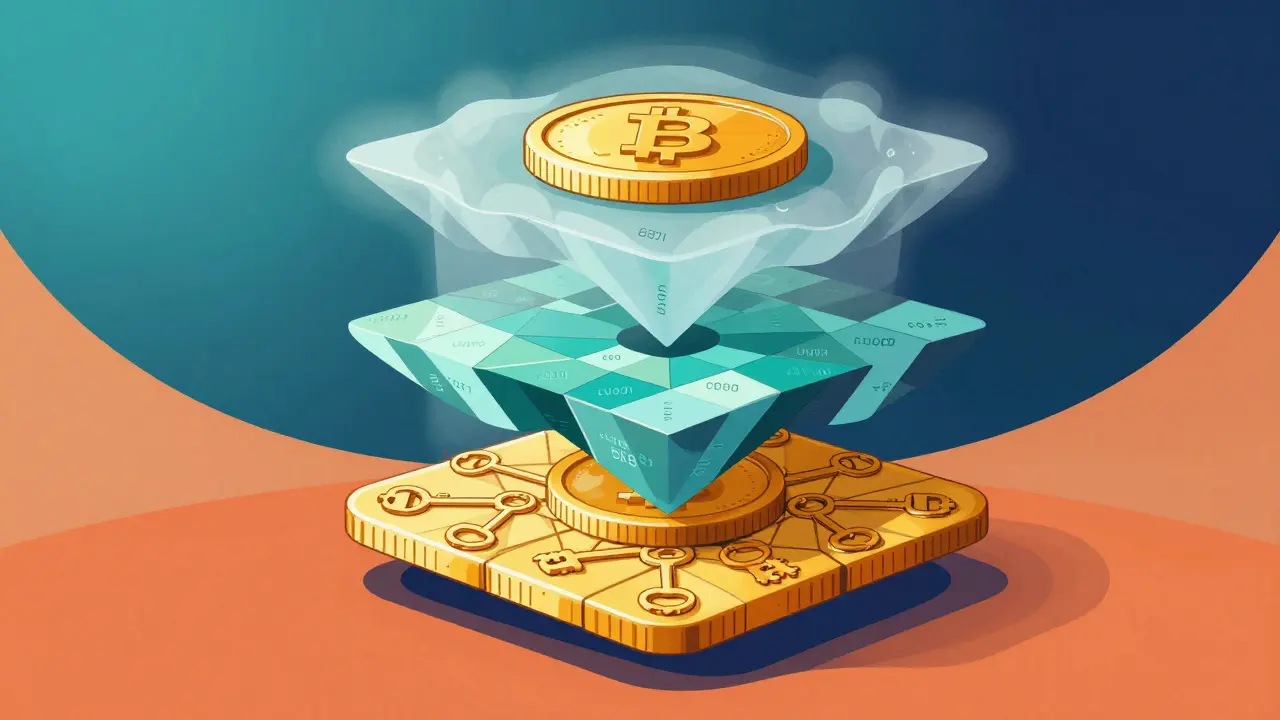
This cryptographic technique is the backbone of privacy in cryptocurrencies like Monero. It doesn’t just hide data; it creates plausible deniability. When you use a ring signature, you are digitally signing a transaction alongside a group of decoy keys pulled from the blockchain. To an outside observer, any one of those keys could have authorized the payment. You are effectively hiding in plain sight within a crowd of strangers.
What is a ring signature?
A ring signature is a type of digital signature that allows a member of a group (the "ring") to sign a message on behalf of the group without revealing which specific member signed it. In cryptocurrency, this means the sender's identity is obscured among multiple potential senders.
The Origin Story: From Academic Theory to Crypto Reality
Ring signatures didn’t start in the world of crypto. They were born in academia. In 2001, three cryptography giants-Ron Rivest, Adi Shamir, and Yael Tauman Kalai-published a paper titled "How to Leak a Secret." They wanted to solve a specific problem: how can someone reveal information anonymously while proving they belong to a trusted group? Their solution was elegant. It allowed a user to generate a signature that validated against a set of public keys, making it computationally impossible to determine which key actually created the signature.
For years, this remained a theoretical curiosity. Then came the rise of Bitcoin. While Bitcoin revolutionized finance, its ledger was fully transparent. Every transaction was traceable back to a wallet address. Privacy advocates saw a gap. If money is truly private, the sender should remain anonymous. Enter Monero. Originally launched as BitMonero in July 2014 and rebranded later that year, Monero adopted ring signatures as a default feature. Unlike other coins where privacy is an optional add-on, Monero baked it into the protocol. This decision fundamentally changed how the network functioned, prioritizing untraceability over transparency.
The technology evolved rapidly. Early versions used small rings of just three keys. As blockchain analysis tools improved, so did the defenses. By 2020, the default ring size had grown to 11 keys. This evolution wasn’t arbitrary; it was a direct response to increasing scrutiny from regulators and analysts trying to de-anonymize transactions.
How Ring Signatures Actually Work
To understand ring signatures, you need to look under the hood. When you initiate a transaction in Monero, your wallet doesn’t just pick random keys to mix yours with. It uses a sophisticated method called gamma distribution to select decoy outputs from the blockchain history. These decoys must be valid, unspent outputs to maintain credibility.
Here is the process step-by-step:
- Key Selection: Your wallet identifies your private spending key and selects several other public keys from the blockchain. Currently, the standard involves mixing your key with 10 others, creating a ring of 11.
- Signature Generation: The system generates a cryptographic proof. This proof demonstrates that one of the keys in the ring possesses the corresponding private key required to authorize the spend, without revealing which one it is.
- Verification: Network nodes verify the signature. They check if the math holds up for the entire group. If the proof is valid, the transaction is accepted. The node cannot distinguish the real signer from the decoys.
This mechanism relies on elliptic curve cryptography, specifically EdDSA on Curve25519. It ensures that even with immense computing power, distinguishing the true signer is statistically improbable. The beauty of this system, as noted by Monero lead researcher Riccardo Spagni, is its improvisational nature. You don’t need to pre-register with a central authority or join a formal group. The "ring" is assembled on the fly for every single transaction.
The Three-Prong Approach to Total Privacy
Ring signatures alone aren’t enough for complete privacy. If only the sender is hidden, but the recipient and amount are visible, patterns still emerge. Monero addresses this with a layered defense strategy often referred to as its "three-prong approach."
| Feature | Function | Privacy Aspect Hidden |
|---|---|---|
| Ring Signatures | Mixes sender's key with decoys | Sender Identity |
| Stealth Addresses | Generates unique destination per transaction | Recipient Identity |
| RingCT (Ring Confidential Transactions) | Hides amounts using Pedersen commitments | Transaction Amount |
Stealth addresses ensure that even if someone knows your public address, they can’t link incoming payments to your account because each transaction generates a unique, one-time address for the recipient. RingCT, introduced in January 2017, hides the value being transferred. It uses Pedersen commitments-a cryptographic technique that proves inputs equal outputs without revealing the actual numbers. Together, these technologies create a fog where no transaction detail is easily linked to another. This comprehensive coverage is why Monero maintains high fungibility. Every XMR coin is theoretically indistinguishable from any other, unlike Bitcoin where "tainted" coins can be flagged and rejected by exchanges.
Ring Signatures vs. Other Privacy Tech
Not all privacy solutions are built the same way. While Monero relies on ring signatures, competitors like Zcash and Dash use different methods. Understanding the differences helps clarify why ring signatures dominate the privacy coin space despite their drawbacks.
Zcash uses zk-SNARKs (zero-knowledge succinct non-interactive arguments of knowledge). This technology allows users to prove a transaction is valid without revealing any details. However, zk-SNARKs historically required a "trusted setup" ceremony, where a group of participants generated parameters. If anyone kept a copy of those parameters, they could forge transactions. Although newer variants mitigate this risk, the initial setup remains a philosophical hurdle for some purists. Additionally, Zcash transactions are smaller (around 1.4 KB) compared to Monero’s larger footprint.
Dash offers PrivateSend, a coin-mixing service. This is an optional feature where users pool their coins with others to break the trail. The problem? Adoption is low. Estimates suggest only 15-20% of Dash users enable PrivateSend. This creates a privacy paradox: if most transactions are transparent, the mixed ones stand out. Monero’s default privacy avoids this issue entirely. With 100% of transactions using privacy features, there is no baseline to compare against, making heuristic analysis much harder.
However, ring signatures have a cost. Monero transactions typically range from 13-15 KB, whereas Bitcoin averages around 250 bytes. This size difference contributes to blockchain bloat and slower processing times. During peak congestion, Monero transactions can take 30-45 seconds to process, compared to Bitcoin’s 5-10 seconds. Users must weigh the value of anonymity against the inconvenience of larger fees and slower confirmations.
Vulnerabilities and Regulatory Pressure
No system is perfect. Critics argue that ring signatures are the "weakest link" in Monero’s privacy stack. Why? Because they rely on statistical obscurity rather than absolute mathematical secrecy of the input. If an analyst can narrow down the possible signers through timing correlations or metadata, the effective anonymity set shrinks.
Dr. Andrew Miller from the University of Illinois noted in a 2019 paper that while ring signatures protect against network-level adversaries, they remain vulnerable to sophisticated chain analysis when combined with other data points. For instance, if you know a specific wallet received funds at time T, and a ring signature transaction occurs at time T+1 with a similar output pattern, the probability of identifying the sender increases.
Regulators are taking notice. The U.S. Internal Revenue Service awarded a $625,000 contract to Chainalysis in August 2020 to develop software capable of analyzing Monero transactions. While Chainalysis CEO Michael Gronager stated in 2022 that breaking ring signatures at scale remains "computationally prohibitive," the intent is clear: governments want visibility. In May 2024, FinCEN issued guidance requiring enhanced due diligence for privacy coins, impacting 78% of U.S.-based exchanges. This regulatory pressure has led to delistings and reduced liquidity, forcing users toward decentralized exchanges like THORChain, where trading volume surged 300% year-over-year in 2025.
The Future: Scaling Privacy with Triptych and Arcturus
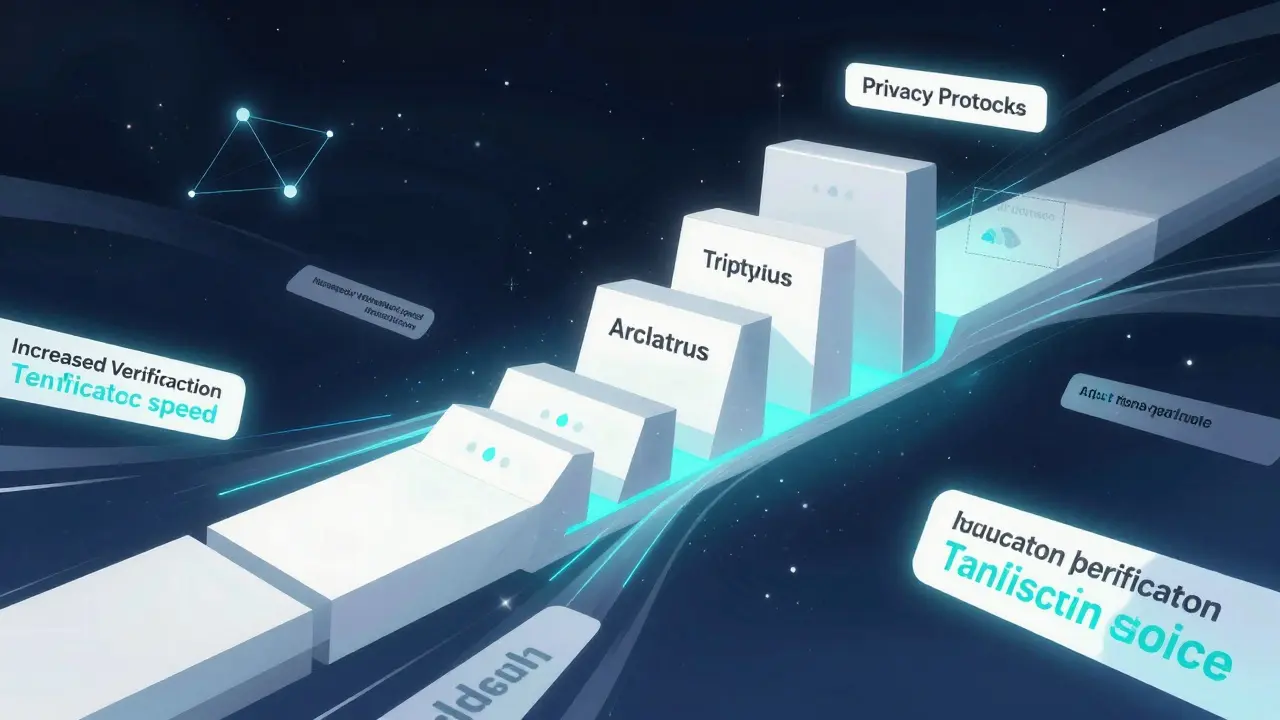
The developers behind Monero are not standing still. Recognizing the limitations of fixed ring sizes, the community is moving toward next-generation protocols. The Triptych protocol, detailed in a 2020 research paper, enables logarithmic scaling. This means you can increase the number of decoys from 10 to 100 without proportionally increasing the transaction size. Tests show this could reduce transaction size by approximately 80% while significantly boosting privacy.
Complementing this is the Arcturus protocol, introduced in early 2024. Arcturus optimizes verification speed by up to 400% through multi-layered ring structures. These advancements aim to solve the scalability issues inherent in traditional ring signatures. Looking ahead, the Lelantus protocol integration, scheduled for Q2 2026, promises to eliminate fixed ring sizes entirely, allowing for dynamic anonymity sets that adapt to network conditions.
These innovations position ring signature technology not just as a niche crypto feature, but as a viable solution for enterprise confidentiality. Gartner predicts that by 2030, 25% of financial institutions will adopt ring signature-based systems for confidential transactions. As long as the demand for privacy persists, the evolution of ring signatures will continue to shape the future of digital money.
Are ring signatures completely secure?
Ring signatures provide strong privacy through plausible deniability, but they are not immune to all attacks. Heuristic analysis and timing correlation can potentially weaken privacy if the ring size is small or if external metadata is available. However, with current default ring sizes of 11 and upcoming protocols like Triptych, they remain highly secure against typical surveillance.
Why are Monero transactions larger than Bitcoin?
Monero transactions include complex cryptographic proofs for ring signatures, stealth addresses, and RingCT. These elements require more data to store and verify, resulting in average sizes of 13-15 KB compared to Bitcoin's ~250 bytes. This trade-off is necessary to ensure sender, recipient, and amount privacy.
Can I use ring signatures on Bitcoin?
No, Bitcoin does not natively support ring signatures. Its protocol is designed for transparency. While some third-party mixing services attempt to obscure trails, they do not offer the cryptographic guarantees of ring signatures integrated into the protocol like Monero does.
What is the difference between RingCT and Ring Signatures?
Ring signatures hide the sender's identity by mixing keys. RingCT (Ring Confidential Transactions) hides the transaction amount using Pedersen commitments. They work together: ring signatures protect who sent the money, while RingCT protects how much was sent.
Is Monero legal to use?
Monero itself is legal in most jurisdictions, including the United States. However, regulatory bodies like FinCEN have issued strict guidelines for exchanges handling privacy coins. Some countries have banned or restricted the listing of Monero on centralized exchanges due to its privacy features, pushing users toward decentralized platforms.





Jessie Smith
July 9, 2026 AT 20:47Look, most of yall are missing the forest for the trees. It's not just about hiding money, it's about the fundamental right to obscurity in a digital panopticon. The academic roots with Rivest and Shamir are often glossed over by the crypto-bros who only care about mooning. This is actually a profound philosophical statement on trust vs verification. I mean, really, do you want your financial history etched in stone forever? That's dystopian shit. The gamma distribution part is clever but honestly, the real genius is the social engineering aspect of making privacy default. If everyone uses it, no one stands out. Simple as that.
Drew M
July 10, 2026 AT 13:10Oh my god this is such a game changer! 🚀✨ I always thought Bitcoin was the end all be all but seeing how Monero handles anonymity is just mind blowing. Like wow. 😲 The fact that they mix your key with 10 others is so smart. It’s like being in a crowd at a concert where everyone looks the same. You can’t tell who started the mosh pit! 💃🕺 Also, the part about stealth addresses is super cool because it means even if people know your address they can’t link payments to you. It’s like having a new email every time someone sends you mail. So private! 🔒💖 I feel so much safer knowing this tech exists. Privacy is sexy guys! 😉
Deep Rahman
July 10, 2026 AT 16:11When we consider the implications of ring signatures we must look deeper into the nature of identity itself and how it is constructed within the digital realm because the act of signing a transaction is not merely a technical process but a social contract that defines our relationship with the network and with each other in ways that are often overlooked by those who focus solely on the cryptographic mechanics rather than the human element of trust and deception that underpins all economic exchange systems throughout history and into the future of decentralized finance which relies heavily on these obfuscation techniques to maintain its integrity against external scrutiny from regulatory bodies who seek to impose order upon chaos.
Melissa Beckwith
July 12, 2026 AT 04:18You are ignoring the critical vulnerability points mentioned in the Miller paper from 2019 which explicitly states that while ring signatures protect against network-level adversaries they remain highly susceptible to sophisticated chain analysis when combined with timing correlations and metadata leaks which effectively shrinks the anonymity set to a statistically insignificant number in many practical scenarios especially when dealing with large transactions or specific output patterns that can be fingerprinted by advanced heuristic algorithms used by firms like Chainalysis who have been awarded significant contracts by the IRS to develop tools specifically designed to de-anonymize Monero users despite their claims that breaking ring signatures at scale is computationally prohibitive which is a claim that has been increasingly challenged by recent advancements in machine learning based clustering techniques.
Josephine Finlayson
July 13, 2026 AT 10:38I think it is wonderful that there are options for privacy! It is important to respect everyone's choice in how they handle their finances. Whether one chooses transparency or anonymity, it should be a personal decision without judgment. The development of Triptych and Arcturus shows that the community is working hard to improve scalability and efficiency, which is very encouraging. We should support innovation that offers different solutions for different needs. Peace and love to all who value privacy! 🌸
Tuan Nguyen
July 13, 2026 AT 22:29The entire premise of 'privacy' here is a facade for illicit activity. The bloated transaction sizes of 13-15 KB compared to Bitcoin's efficient 250 bytes are not a feature; they are a tax on network resources imposed by ideological zealots. The reliance on statistical obscurity rather than absolute mathematical proof of non-linkability makes this system fundamentally flawed for any serious enterprise application. The regulatory crackdowns are not an attack on freedom; they are a necessary correction to a market segment that refuses to comply with basic anti-money laundering standards. The delistings are inevitable consequences of poor design choices prioritizing obfuscation over utility.
Hazel Fruitman
July 15, 2026 AT 06:31i mean like... why would anyone want to hide their money? thats sus af. if u got nothing to hide then u got nothing to fear right? its just shady stuff. i dont trust this whole monero thing. feels like a scam to me tbh. why cant we just use bitcoin and be done with it? less drama more gains. also the spelling in this post is kinda bad lol. fix ur grammar before u try to teach us cryptography. smh.
Autumn Story
July 17, 2026 AT 03:49I really appreciate the detailed explanation here!! It helps so much to understand the difference between RingCT and Ring Signatures because i always get confused.. Thank you for clarifying that one hides the sender and the other hides the amount. It’s great to see that technology is evolving to protect our data. I hope more people learn about this so we can make informed choices about our digital privacy. Keep up the good work sharing knowledge! 😊