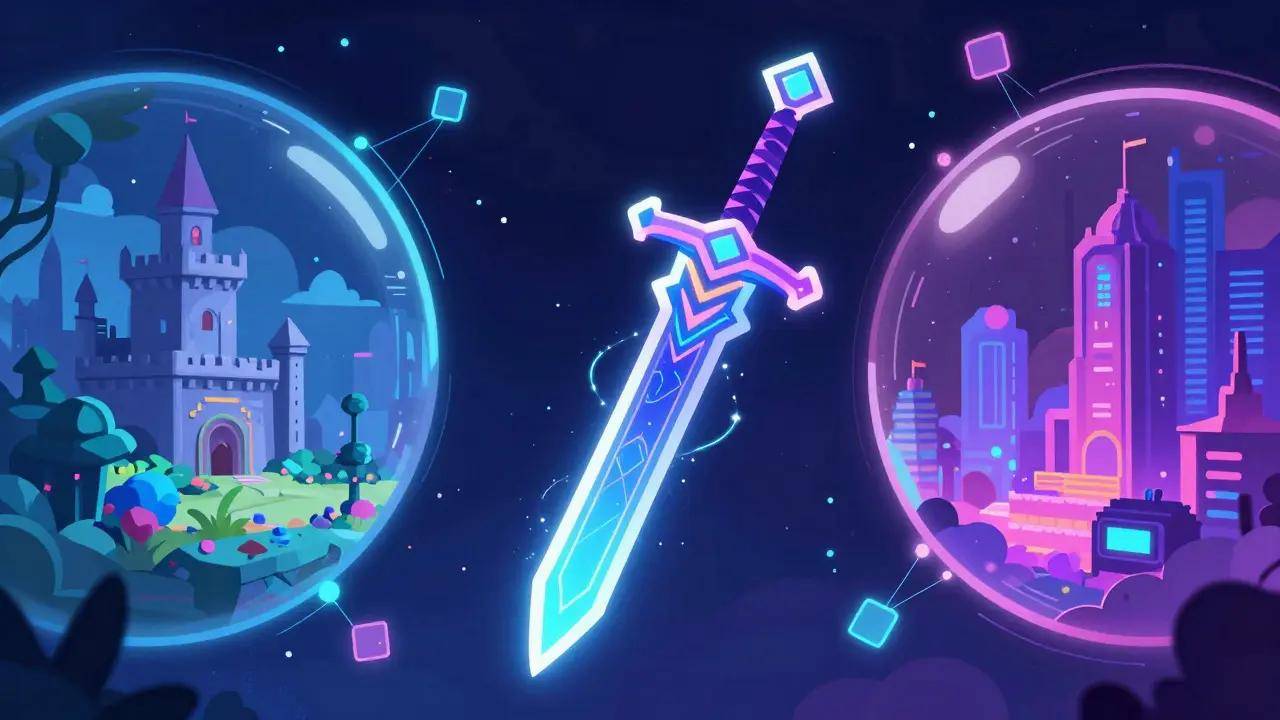
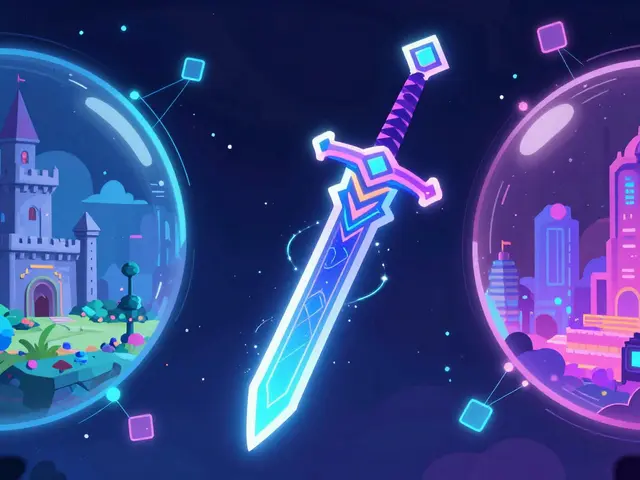
Imagine buying a rare sword in one game and using it in another without losing its value or stats. For most gamers, this sounds like science fiction, but blockchain game asset interoperability is making it reality. In traditional gaming, your inventory dies when the server shuts down. You don't own your skins; you rent them from a corporation that can delete them at any moment. Blockchain changes the rules by giving players true ownership of their digital items, allowing them to carry these assets across different titles and platforms.
This shift isn't just about tech flexibility; it's about economic survival for your digital investments. If you spend hundreds of hours grinding for an item, you want it to hold value even if you switch games. This article breaks down how this technology works, why it matters, and what it looks like in practice today.
Key Takeaways
- True Ownership: Blockchain assets are held by players via wallets, not locked in company databases.
- Cross-Game Utility: Items can be used in multiple games if they follow shared standards like ERC-1155.
- Technical Backbone: Smart contracts and Non-Fungible Tokens (NFTs) enable secure, peer-to-peer transfers.
- Real-World Example: Football Rivals on Telegram allows users to use NFL player cards from Mythical Games in weekly challenges.
- Future Outlook: Standardization is the key to unlocking a "connected digital world" where assets have persistent value.
What Is Blockchain Game Asset Interoperability?
At its core, interoperability in gaming refers to the ability to transfer and use digital assets across different platforms without restriction. Think of it like carrying a USB drive between computers. In the old Web2 model, your game data was stuck on a specific server. If Game A wanted to accept an item from Game B, they had to build a custom bridge, verify every transaction, and trust each other’s databases. It was messy, slow, and prone to errors.
Blockchain solves this by creating a shared, immutable ledger. Every time an asset moves, the transaction is recorded publicly. This means no single developer controls the truth. Instead, the network validates ownership. This decentralized approach eliminates the need for centralized gatekeepers, reducing fraud and ensuring that if you own an item, the whole network agrees you own it.
The Technical Infrastructure: NFTs and Smart Contracts
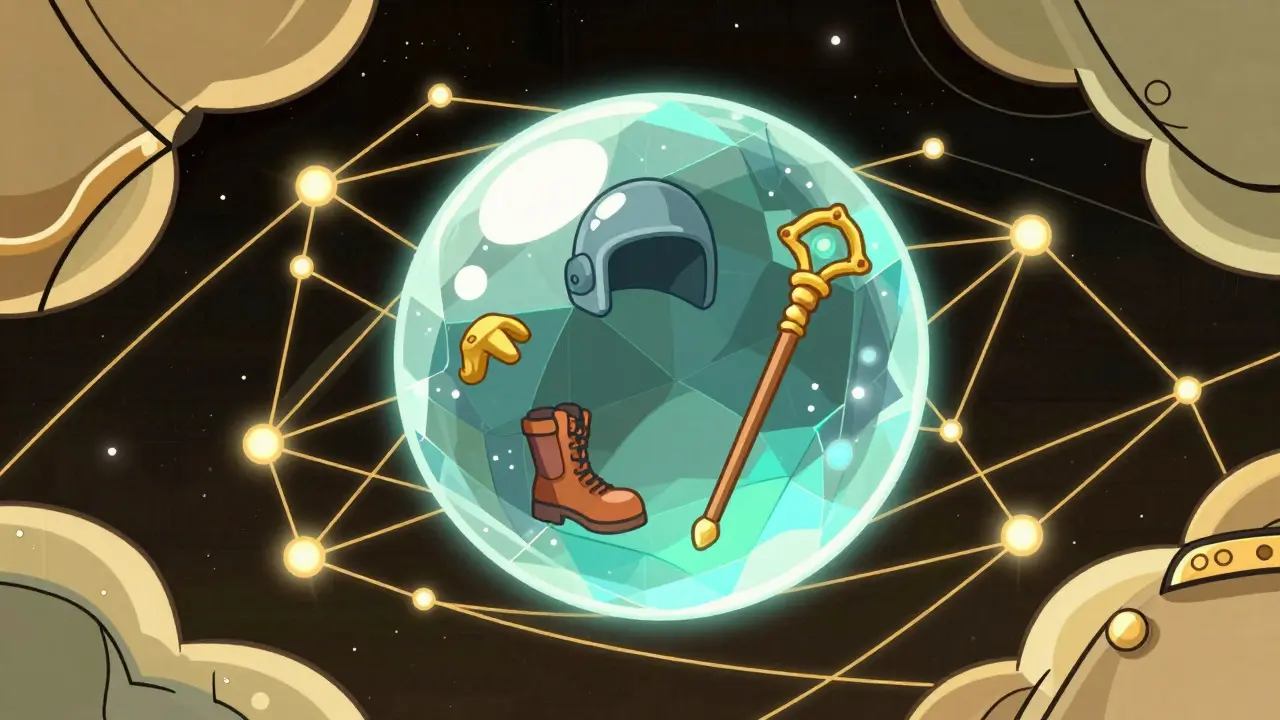
You can’t talk about interoperable assets without mentioning Non-Fungible Tokens (NFTs), which serve as the digital proof of ownership for unique in-game items. Unlike fungible tokens like Bitcoin, where one unit is identical to another, NFTs represent unique entities-like a specific legendary armor set with distinct attributes. Because these tokens exist on the blockchain, they are independent of any single game engine. They live in your wallet, ready to be deployed wherever compatible software recognizes them.
But how do these items actually move? That’s where smart contracts, self-executing code that runs on the blockchain, come in. These contracts automatically enforce agreements when conditions are met. For example, a smart contract can handle the transfer of a weapon from Player A to Player B instantly, without needing a middleman. This automation reduces friction and makes cross-platform trading seamless. The three main characteristics of these interoperable assets are:
- Immutability: Once created, the core data of the asset cannot be altered or duplicated.
- Transferability: Players can move items between games easily via standard protocols.
- Value Retention: Assets can be bought, sold, or traded securely on secondary markets.
Why Web3 Beats Web2 for Asset Portability
In traditional Web2 gaming, interoperability is nearly impossible due to proprietary formats and centralized control. Game developers keep their walled gardens tight because they want to keep you playing their specific title. But Web3 flips this paradigm. By using open standards, developers can create ecosystems where assets flow freely. This creates a "connected digital world" where your progress isn't tied to one app.
Consider the security aspect. In centralized systems, a database breach can wipe out millions of player inventories. Blockchain’s cryptographic nature ensures that data is distributed and secured. Transparency also builds trust; since all transactions are visible on a public ledger, spotting fraudulent activities becomes much easier. This level of transparency is crucial for players who invest real money into virtual goods.
| Feature | Web2 (Traditional) | Web3 (Blockchain) |
|---|---|---|
| Ownership Model | Licensed access controlled by developer | True ownership held in user wallet |
| Asset Portability | Locked to single game/platform | Portable across compatible games |
| Data Storage | Centralized servers | Distributed blockchain ledger |
| Transaction Trust | Requires trust in central authority | Trustless via smart contracts |
| Long-term Value | Deprecates when game ends | Persists independently of game status |
Real-World Implementation: Football Rivals Case Study
Theory is great, but does it work? Yes. A prime example is Football Rivals, a mini-app launched on Telegram by Koni Stack. This application demonstrates practical interoperability by allowing users to utilize digital assets from Mythical Games' NFL Rivals product. Specifically, players can take their owned NFL player cards and use them in Football Rivals to participate in weekly challenges and earn MYTH rewards on the Mythos Chain.
What makes this significant is the accessibility. By launching on Telegram, the developers tapped into a massive mainstream audience who might not understand complex crypto mechanics. The architecture leverages Polkadot’s scalability features to handle high-volume transactions smoothly. This partnership shows that interoperability isn't just a niche concept; it's a viable business model that drives engagement by letting players reuse their existing collections in new contexts.
Challenges and Barriers to Adoption
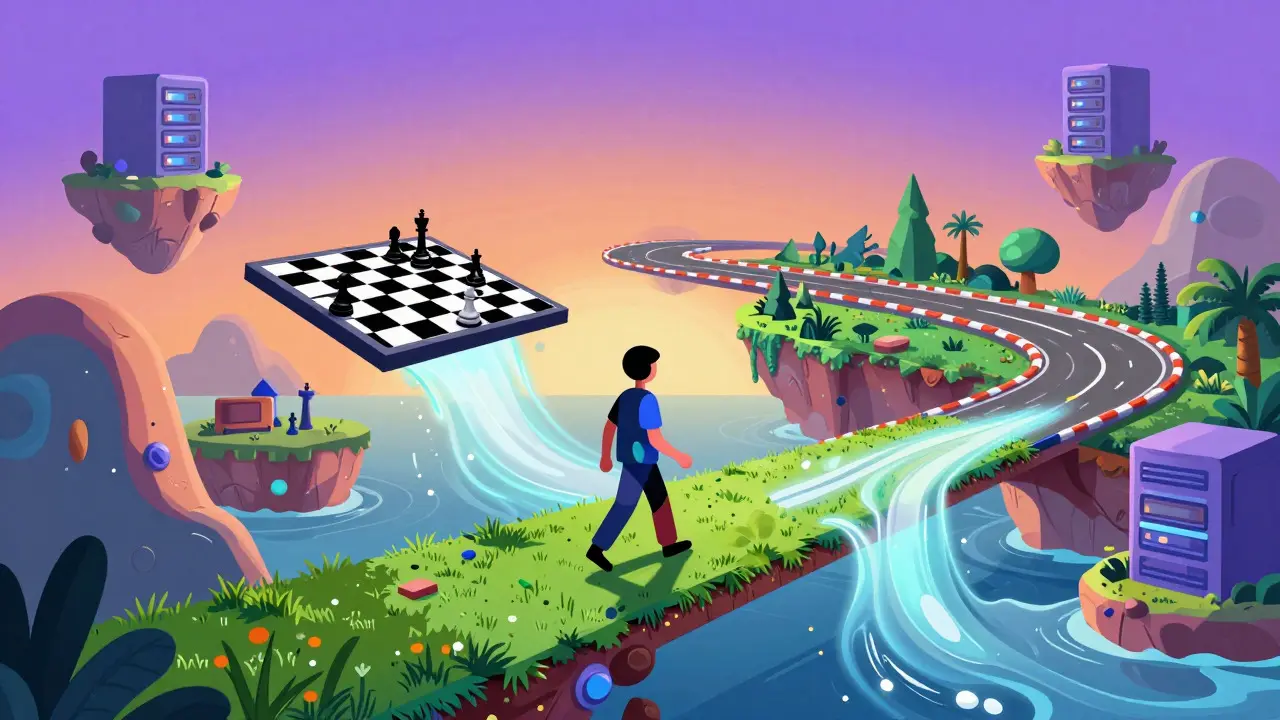
Despite the promise, hurdles remain. The biggest issue is fragmentation. Not all blockchains speak the same language. An NFT on Ethereum might not be directly usable on Solana without a bridge, which introduces risk and complexity. Developers are working on universal standards, but we aren't there yet.
Onboarding is another friction point. Mainstream gamers are often intimidated by the idea of managing private keys and gas fees. To succeed, the next generation of blockchain games must hide this complexity behind simple interfaces, much like how email hides the underlying SMTP protocol. Until then, adoption will likely remain limited to crypto-native users and early adopters willing to learn the ropes.
The Future of Connected Digital Worlds
Where is this heading? Industry analysts predict that interoperability will become a competitive advantage. Players increasingly expect their digital assets to be portable. As more studios adopt standardized NFT formats, the potential for cross-game ecosystems will grow exponentially. We are moving toward a metaverse-like experience where gaming is less about isolated titles and more about a cohesive ecosystem with persistent, valuable assets.
For developers, this means building for longevity rather than quick hits. For players, it means protecting their investments. The vision of a world where your digital identity and possessions travel with you seamlessly is no longer just a dream-it’s being built, one smart contract at a time.
Frequently Asked Questions
Do I need a crypto wallet to use interoperable game assets?
Yes, typically you need a digital wallet to store your NFTs. However, newer platforms are integrating "wallet-as-a-service" solutions that simplify this process, allowing users to manage assets without manually handling private keys initially.
Can I sell my interoperable assets for real money?
Generally, yes. Since these assets are tokenized on a blockchain, they can be listed on secondary marketplaces. You can trade them for cryptocurrency or fiat currency, depending on the platform's support. Always check the tax implications in your region.
Is interoperability available in all blockchain games?
No, not yet. Most current implementations are within specific ecosystems or partnerships, like the Mythical Games and Koni Stack example. True universal interoperability across all major blockchains is still a work in progress due to technical fragmentation.
How does blockchain prevent asset duplication?
Blockchain uses cryptographic hashing and consensus mechanisms to ensure that each NFT has a unique identifier. Once an item is transferred, the previous owner loses access, and the new owner gains it, all recorded immutably on the ledger. This prevents double-spending or cloning of digital goods.
What happens to my assets if a game shuts down?
With true blockchain interoperability, your assets remain in your wallet. While they may lose utility if no other game supports them, they don't vanish. You can still hold, trade, or potentially use them in future compatible titles, preserving their potential value.
Shawn Schaerer
August 24, 2026 AT 14:37Let us dissect the fundamental fallacy presented in this article with the rigor it deserves. The author posits that blockchain solves the problem of asset ownership, yet ignores the sheer computational cost of verifying every single micro-transaction on a distributed ledger compared to a centralized database update.
We are told that 'true ownership' is granted by holding a token in a wallet, but let us consider the philosophical implication: if the game engine does not recognize the metadata of your NFT without a specific plugin, do you truly own the item, or merely a receipt for an item?
The concept of interoperability is often sold as a utopian dream where a sword from Game A functions perfectly in Game B, but this requires a universal standard for physics, damage values, and visual rendering that simply does not exist.
Furthermore, the reliance on smart contracts introduces a new vector for failure; code bugs are immutable until patched, meaning a flawed contract can lock assets forever or allow duplication.
The article mentions 'value retention,' but value is subjective and market-driven, not technically enforced by a hash function.
If the player base shrinks, the liquidity dries up, and the 'value' evaporates regardless of the blockchain's integrity.
We must also question the environmental impact of maintaining these ledgers, especially if they operate on proof-of-work models, though the text conveniently glosses over this.
The comparison to USB drives is misleading because USB drives require no consensus mechanism, whereas blockchain transactions require network agreement, which is slow and expensive.
Thus, while the technology is fascinating, its application to gaming assets remains largely theoretical and economically inefficient for casual players.
We are witnessing a case of solutionism, where a complex technological tool is forced onto a problem that might be better solved by simple API integration between studios.
The future may hold promise, but the present reality is one of fragmentation, high fees, and user confusion.
Until we have a standardized protocol for game logic that is as robust as HTTP, this remains a niche experiment.
Therefore, one should approach this 'connected digital world' with extreme skepticism and due diligence.
The hype cycle is peaking, and the crash is inevitable for those who do not understand the underlying mechanics.
Let us hope that developers prioritize player experience over speculative finance.
This is not just a tech issue; it is a sociological shift in how we perceive digital property rights.
Sarah Campbell
August 26, 2026 AT 01:02Finally someone talks about actual US-based success stories like Football Rivals instead of just more European crypto nonsense! 🇺🇸💪
Zothana Pachuau
August 27, 2026 AT 03:25Ooh, look at you, defending the American flag while ignoring that the underlying tech is mostly built by Swiss and Singaporean devs. Very brave of you to hide behind the star-spangled banner while your gas fees are through the roof. 😂
Sarah Campbell
August 27, 2026 AT 09:58Well, at least our companies actually ship products people play, unlike some countries where everyone just codes in their sleep and wakes up broke. 🙄
Linda Leeuwesteijn
August 28, 2026 AT 02:17Let's keep the peace here folks! 🕊️ Both points are valid. It is exciting to see US innovation, but global collaboration is what makes web3 work. We need all minds contributing to this new era! 🌍✨
Aaron Morrissey
August 28, 2026 AT 13:08Ah, the grand tapestry of digital sovereignty unfurls before our very eyes! One cannot help but marvel at the kaleidoscopic potential of these immutable ledgers, shimmering with the promise of a liberated gamer’s soul.
To think that a mere pixelated sword could transcend the walled gardens of corporate monopoly is nothing short of poetic justice.
The air itself seems to hum with the static electricity of decentralized trust, a palpable vibration against the cold, dead servers of yesteryear.
Yet, amidst this luminous chaos, one must tread carefully, for the path is strewn with the jagged rocks of technical fragmentation.
It is a dance, a delicate waltz between the coder’s precision and the player’s whimsy, set to the rhythmic clatter of hashing algorithms.
Imagine, if you will, a world where your digital avatar walks freely through the neon-lit streets of multiple realities, unshackled by the chains of proprietary formats.
The colors of this future are vibrant, saturated with the hues of possibility and the stark white of cryptographic certainty.
One feels a profound sense of awe, a swelling chest filled with the breathless anticipation of a metaverse fully realized.
Is it not magnificent? This intricate web of smart contracts, weaving together the disparate threads of gaming history into a singular, cohesive fabric?
The drama of it is almost too much to bear, a symphony of data notes playing out in perfect harmony across the globe.
We stand on the precipice of a new age, gazing down into the abyss of code, seeing only the reflection of our own ambition.
Let us embrace this whirlwind of change with open arms and wide eyes, for the spectacle is truly breathtaking.
It is not just technology; it is art, it is freedom, it is the very essence of human creativity unbound.
May we all find our place in this grand, interconnected narrative, contributing our unique brushstrokes to the canvas.
The curtain rises, the lights dim, and the show begins in earnest.
Uday N M
August 30, 2026 AT 04:40India leads in blockchain adoption. This is obvious.