Imagine hiring a remote developer who writes clean code, meets deadlines, and seems totally normal. Then you find out they’re actually a state-sponsored operative stealing your company’s data and funneling millions in stablecoins back to Pyongyang. That’s not a spy thriller plot; it’s the current reality for U.S. tech firms dealing with North Korean cryptocurrency networks. As of late 2025, these schemes have stolen over $2.1 billion in just six months, according to TRM Labs. If you run a Web3 startup or manage compliance, ignoring this isn’t an option anymore.
The Scale of the Problem
The U.S. Treasury’s Office of Foreign Assets Control (OFAC) has been aggressively targeting the infrastructure that allows the Democratic People's Republic of Korea (DPRK) to bypass economic blockades. For years, we thought of North Korea as isolated. But their digital footprint is massive. In August 2025 alone, OFAC designated several key players, including Russian national Vitaliy Sergeyevich Andreyev and North Korean individual Kim Ung Sun. Why? Because they weren’t just moving money; they were orchestrating a complex web of fraud that directly funds weapons programs.
This isn't new, but the intensity has changed. Previous sanctions in July 2025 laid the groundwork, showing that the administration views these IT worker schemes as a direct threat to American businesses. Under Secretary John K. Hurley noted that these workers don't just work-they steal data and demand ransom. It’s a dual-threat model: legitimate service provision masking illicit intelligence gathering.
How the IT Worker Scheme Actually Works
You might wonder how a single country manages to embed thousands of workers into Western companies without getting caught. The method is surprisingly low-tech but highly effective. North Korean operatives create fake identities using stolen personal information. They populate profiles on platforms like GitHub, CodeSandbox, and Freelancer with portfolios that look convincing enough for remote hiring managers who rarely conduct video interviews.
Once hired, these "employees"-often tracked by security researchers under names like Famous Chollima or Jasper Sleet-do two things simultaneously. First, they perform actual coding tasks to maintain their cover. Second, they scout the internal network for valuable assets. This reconnaissance phase is critical. By understanding the company’s architecture, they can later execute more sophisticated attacks or simply sell proprietary data. The revenue generated from their salaries, often paid in USDC or ETH, is then laundered through a mix of centralized exchanges and self-hosted wallets before being converted to cash via Over-The-Counter (OTC) brokers.
Key Entities and Recent Designations
To understand the enforcement landscape, you need to know who OFAC is actually naming. The recent designations aren't random; they target specific nodes in the laundering network. Here is a breakdown of the primary entities involved in the latest wave of sanctions:
| Entity Name | Type | Role in Scheme | Location/Jurisdiction |
|---|---|---|---|
| Vitaliy Sergeyevich Andreyev | Individual | Facilitated currency conversion and logistics for IT workers | Russia |
| Kim Ung Sun | Individual | Managed financial transfers worth ~$600k in crypto-to-cash conversions | North Korea/Overseas |
| Shenyang Geumpungri Network Technology Co., Ltd | Front Company | Provided cover for IT worker deployment and payment processing | China |
| Korea Sinjin Trading Corporation | Trading Entity | Eased sanctions evasion through trade-based money laundering | North Korea |
| Chinyong Information Technology Cooperation Company | IT Firm | Deployed workers for freelance IT work and crypto theft | China/Laos/Russia |
Notice the geographic spread. These aren't just North Korean nationals operating in isolation. They rely heavily on facilitators in Russia, China, and the UAE. The DOJ’s June 2025 civil forfeiture complaint highlighted this international coordination, seizing over $7.7 million in digital assets tied to identities like 'Joshua Palmer' and 'Alex Hong.' These personas collected stablecoin payments from U.S. employers, routing funds through complex chains to senior DPRK operatives like Kim Sang Man and Sim Hyon Sop.
The Technical Laundering Pipeline
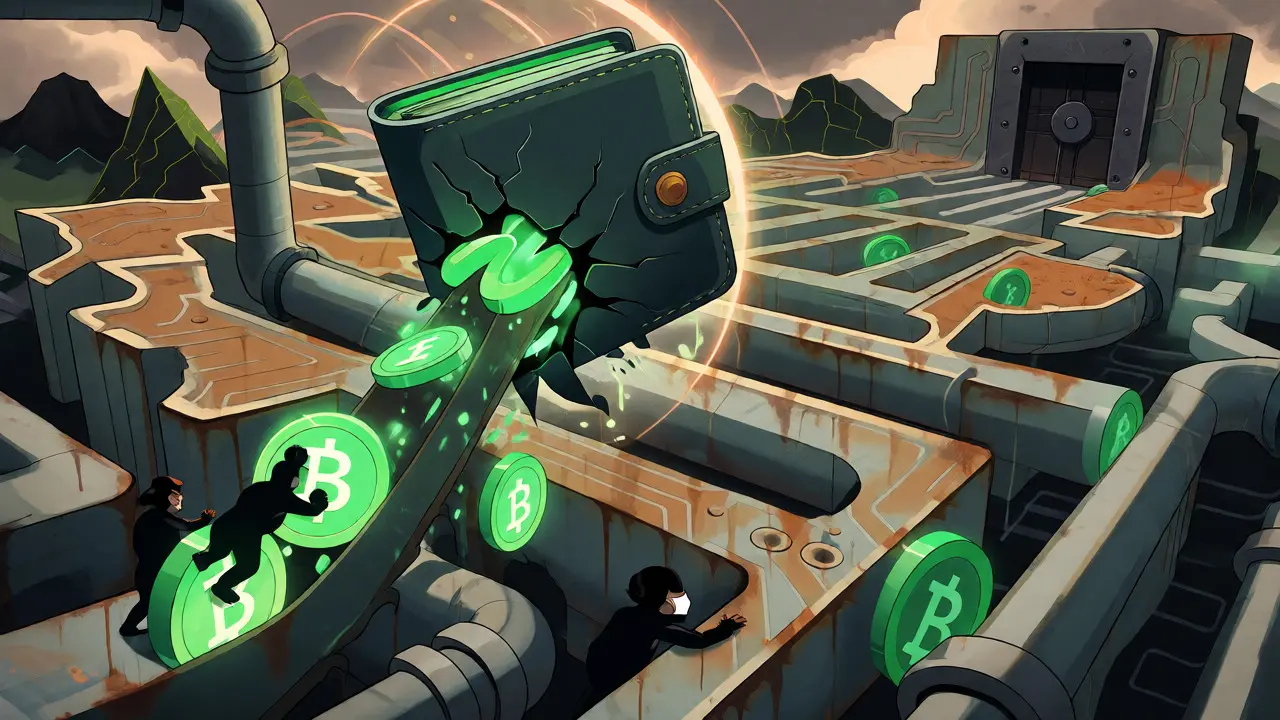
How does digital gold turn into hard currency for missile parts? The pipeline is sophisticated. Workers receive payments in stablecoins like USDC because they are easy to transfer and hold value. However, you can’t buy steel or microchips with USDC directly in most sanctioned jurisdictions. So, the funds move through a series of hops.
- Collection: Salaries arrive in self-hosted wallets controlled by the operatives.
- Fragmentation: Funds are split across multiple addresses to break transaction trails. This is where blockchain analysis firms like TRM Labs come in, tracking behavioral overlaps with known DPRK clusters.
- Consolidation: Smaller amounts are aggregated into larger pools at centralized exchanges or OTC desks.
- Conversion: An OTC broker-some of whom have also been sanctioned-converts the crypto into fiat currency (USD, CNY, or RUB).
- Transfer: Cash is physically or digitally transferred to accounts linked to the Workers' Party of Korea.
This process highlights why simple wallet screening isn't enough. You need to look at the entire lifecycle of the asset. A sudden spike in volume from a "freelancer" followed by immediate withdrawal to a non-U.S. exchange should raise red flags. Furthermore, the use of IP addresses from unexpected locations-like a worker supposedly in New York logging in from a server farm in Moscow-is a classic tell.

Why This Matters for Your Business
If you’re a founder or a compliance officer, this affects your bottom line. The Department of Justice isn't just chasing bad actors; they are protecting intellectual property. When a North Korean IT worker embeds themselves in your team, they aren't just taking your money. They are mapping your database structures, identifying your API keys, and potentially planting backdoors. The FBI and Homeland Security Investigations have emphasized that this creates a risk of both financial loss and data breaches.
Consider the case of a mid-sized DeFi protocol that hired three remote developers in early 2024. Two turned out to be linked to the Wagemole threat group. While they did write functional smart contracts, they also exfiltrated user analytics data that was later used to launch a targeted phishing campaign against the protocol’s largest investors. The cost of remediation far exceeded the salaries paid.
Global Coordination and Future Outlook
Enforcement is no longer a solo act. In August 2025, the U.S. State Department issued joint statements with Japan and South Korea regarding these threats. This multilateral approach acknowledges that DPRK networks operate globally. A front company in Shenyang might hire a worker who logs in from a proxy in Dubai, while the money flows through a bank in Singapore. Cracking this requires shared intelligence and synchronized sanctions.
As we move further into 2026, expect OFAC to expand its list. Investigations are ongoing into additional facilitator networks across Southeast Asia. Blockchain analysts predict that as traditional banking channels tighten, North Korea will increasingly rely on privacy coins and decentralized finance (DeFi) protocols to obscure transactions. This makes real-time monitoring tools essential for any entity handling significant crypto volumes.
What exactly are OFAC sanctions on North Korean crypto networks?
These are legal restrictions imposed by the U.S. Treasury's Office of Foreign Assets Control. They prohibit U.S. persons and entities from engaging in transactions with designated individuals and companies suspected of facilitating North Korea's illicit revenue generation, particularly through cryptocurrency theft and fraudulent IT worker schemes.
How do North Korean IT workers hide their identity?
They use curated fake identities created from stolen personal data. These personas have consistent histories on platforms like GitHub and LinkedIn, often managed by teams who handle communication and task delivery remotely. They frequently reuse these identities across different job postings to build credibility.
Why is cryptocurrency preferred by North Korean operatives?
Cryptocurrency allows for fast, borderless transfers that are harder to intercept than wire transfers. Stablecoins like USDC provide price stability, reducing volatility risk during the transfer process. Additionally, the pseudonymous nature of blockchain transactions helps obfuscate the final destination of funds when mixed with other activities.
What is the role of OTC brokers in these schemes?
Over-The-Counter (OTC) brokers facilitate large trades between buyers and sellers outside of public exchanges. In these schemes, they convert bulk cryptocurrency holdings into fiat currency (cash). Some brokers have been sanctioned for knowingly assisting in the laundering of funds derived from North Korean cybercrime.
Can U.S. companies be penalized for hiring sanctioned individuals?
Yes. If a U.S. company engages in business with a person or entity listed on the OFAC Specially Designated Nationals (SDN) list, they may face penalties. Ignorance is not always a defense if reasonable due diligence was not performed. Screening candidate identities and payment addresses against updated sanction lists is crucial.
Which agencies are involved in enforcing these sanctions?
The primary agency is OFAC within the Department of the Treasury. They work closely with the Department of Justice (DOJ), the Federal Bureau of Investigation (FBI), and Homeland Security Investigations (HSI). International partners, including those in Japan and South Korea, also play a vital role in intelligence sharing and coordinated actions.